Say you run a small bakery in Austin. Last Sunday night you spent two hours in Ads Manager building what felt like the perfect audience. Women 28 to 50, within five miles, interested in baking and farmers' markets, past customers excluded. You even made a lookalike.
The ad got a handful of clicks and one sale. Probably your cousin.
More often than not, the audience isn't the problem. In 2027 the bigger lever on Facebook and Instagram is the ad itself, and Meta has more or less said so. In late October it published a dense engineering post about the new version of Andromeda, the system that decides which ads even get a chance to be shown. Buried in the GPU talk is something every small advertiser should understand.
So let me translate it, flag the numbers that deserve a pinch of salt, and get practical.
What Meta actually changed
Meta doesn't pick your ad in one step. First there's a quick shortlisting stage called retrieval, which narrows "a vast pool of eligible ads down to a small set of strong candidates in milliseconds." After that, heavier ranking models look at the survivors in detail, and one ad wins the slot.
Andromeda is that first stage. If your ad doesn't make the shortlist, the clever ranking models never see it.
According to Meta's engineering post from October 28, 2026, the rebuilt Andromeda "scores every eligible ad" and surfaces the top candidates "at over one billion ads per second." That billion figure is for the full production pipeline on a single GPU server. The scoring part on its own runs at more than 10 billion ads per second on one Nvidia GH200 chip. Meta says that's roughly 100 times the throughput of the 2024 version, while doing about 300 times less computing work than the old retrieval model.
Forget the chips. The word that matters is "every."
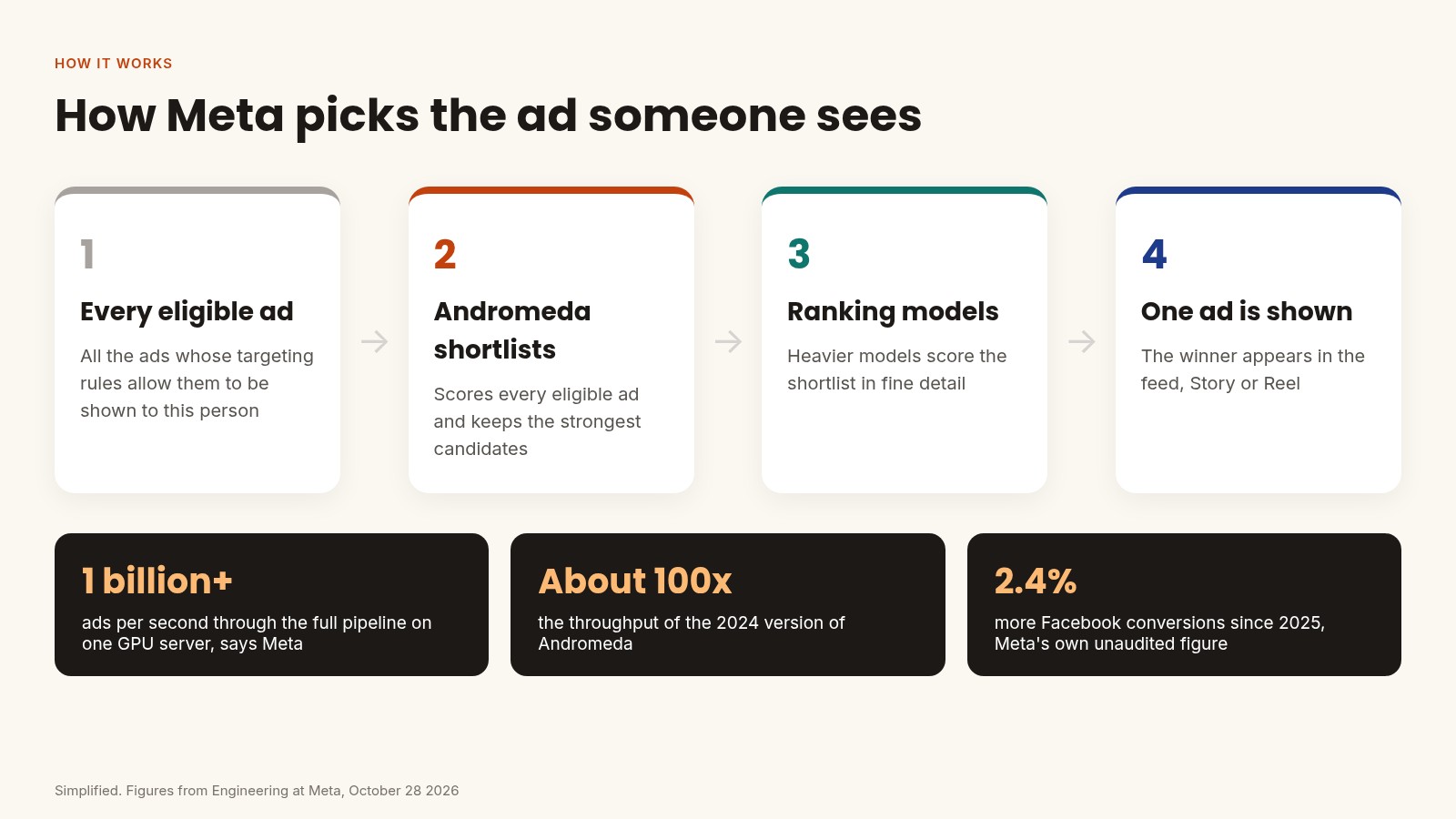
Notice that word "eligible," though. Your targeting rules haven't vanished. Meta says the system still enforces "advertisers' targeting rules" when it matches ads. So targeting decides who is allowed to see your ad. It just has much less say over who actually does.
About that 2.4% conversion lift
The post includes one line that'll end up in a lot of marketing emails. "Since 2025, Meta Andromeda has delivered a 2.4% increase in conversions on Facebook."
Nice number. But it's Meta's own figure, reported by Meta about Meta, and nobody outside the company has audited it. PPC Land went through the claim carefully and pointed out that there's no end date, no baseline, no description of how it was measured and no figure for Instagram.
I'd read 2.4% as a sign of direction and nothing more. It says nothing about what your account will do next month.
Why this pushes the work onto your creative
The engineering post never tells anyone to make more ads. For that you have to read what Meta tells advertisers directly, and there it's been unusually blunt.
Back in April 2025, in a piece on creative diversification and Andromeda, Meta wrote that "the focus has shifted from niche targeting to creative diversification as the best lever to find the most relevant audiences."
Then in December 2025 it explained the mechanics in Demystifying Creative Diversification. Andromeda lets "only the most relevant and distinct creatives move forward." And the ads system "groups together ads that share key visual and thematic attributes," treating look-alikes as "variations of the same creative."
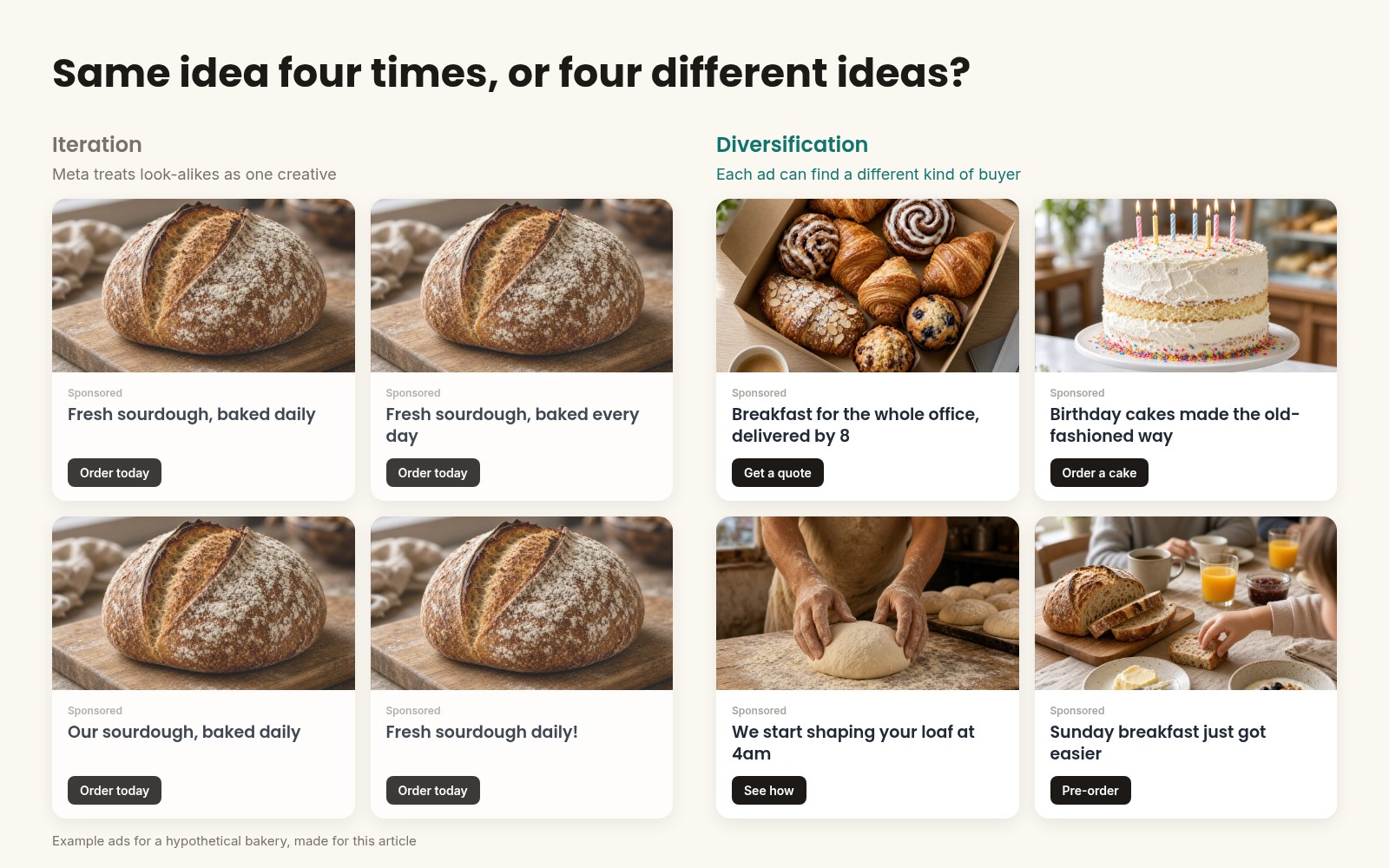
That second part changed how I think about testing. If you upload ten ads that share a photo and differ by a word or two, Meta may well treat them as one idea. You've done ten ads' worth of work for one ad's worth of reach.
And the competition is growing. Meta says generative AI tools have helped advertisers "rapidly create hundreds of millions of new ads."
| Targeting first | Creative first | |
|---|---|---|
| Where your time goes | Interests, lookalikes and age brackets | New angles, copy and visuals |
| How many ads | Two to four per ad set, tweaked | 20 or more genuinely different ads |
| What testing means | Small A/B edits | New concepts every week |
| Who finds the buyer | You, through audience settings | Meta's AI, reading your creative |
| Biggest risk | Audience too narrow to learn | Ads too similar to count as separate ideas |
Tweaking an ad isn't the same as a new idea
Meta draws a clear line here, and most small businesses are on the wrong side of it.
Iteration is what we've all been taught. Same picture, new headline. Meta calls it "manual A/B testing to refine assets, formats, and messages," and it has its uses, but it isn't variety.
Diversification means genuinely different ads made for different people or different reasons to buy. Meta's own example is a Reels ad aimed at Gen Z next to a creator ad that speaks to new moms. Two different people, two different reasons, two different-looking ads.
Back to the bakery. "Fresh sourdough, baked daily" and "Fresh sourdough, baked every day" are the same ad. Office breakfast boxes and birthday cakes are two different reasons to walk in.
So how many ads do you actually need?
Meta's published advice, in Three steps to optimize your performance with creative diversification, is to keep at least 20 diversified ads running in Advantage+ shopping campaigns (now called Advantage+ sales campaigns) and to put 20 to 30 percent of your budget toward testing new ones. It says the strongest advertisers launch new ads every week, while admitting that people just starting out may need a slower schedule.
What I'd suggest is to aim for about ten genuinely different angles, then make each one in two formats, a square for the feed and a vertical version for Stories and Reels. That gets you to twenty ads without having to dream up twenty separate ideas. Ten isn't a Meta number, by the way. It's just a floor that forces real variety.
Here's what ten angles could look like for our Austin bakery.
| Angle | What it does | Example headline |
|---|---|---|
| Pain point | Names a small frustration | Out of bread again at 8pm? We're open till 9 |
| Outcome | Shows the result | Sunday breakfast, sorted before anyone's awake |
| Social proof | Borrows a regular's trust | "Best loaf on the street" says Margaret, a regular since 2019 |
| Offer | Gives a reason to act now | Buy two loaves, get the third free this week |
| Urgency | Adds a real deadline | Holiday cake orders close this Friday |
| Behind the scenes | Builds a bit of affection | Shaped by hand at 4am, on your table by 7 |
| Use case | Opens up a new buyer | Breakfast boxes for 10, delivered to your office |
| Persona | Talks to one kind of person | New to sourdough? Start with our mild white loaf |
| Objection | Answers a doubt head on | Costs more, stays fresh for four days |
| Comparison | Contrasts the alternative | Six ingredients in ours. Count the ones in a supermarket loaf |
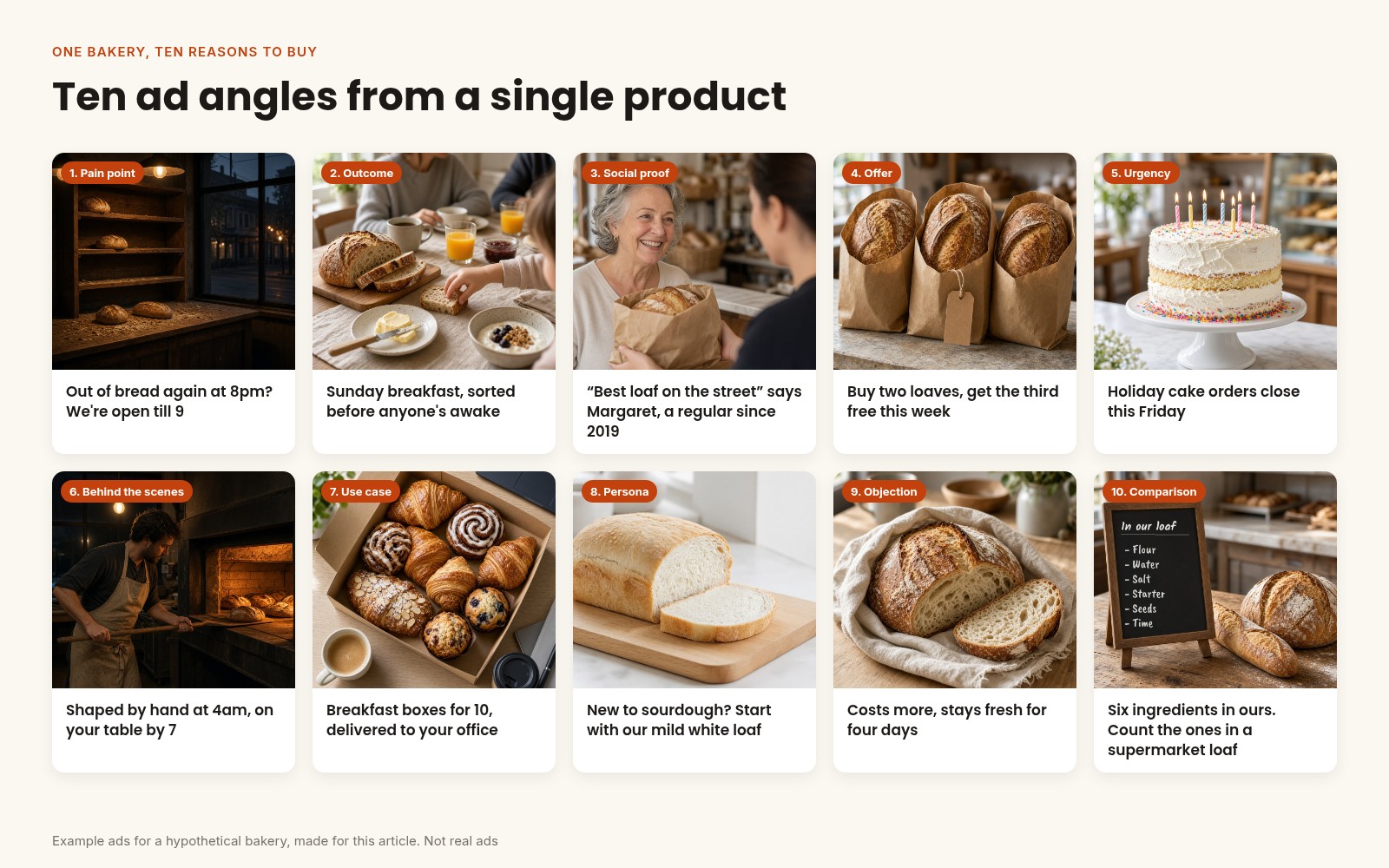
The use-case ad might reach office managers, the persona ad nervous first-timers. You didn't build an audience for either. The ad did the targeting.
One more thing. Make them look different as well as read differently. Since Meta groups ads by visual similarity, ten new headlines on the same loaf photo won't buy you much. Change the photo, the setting, the people in it or the format.
What to do with your targeting now
I'm not telling you to throw your audiences away. I'm telling you to stop spending your best hours on them.
For most small budgets I'd keep it simple. Set your location and any age limits that genuinely apply, exclude existing customers if you're running a first-order offer, and let Advantage+ handle the rest. Leave Advantage+ placements on so your ads can show wherever they do well, which Meta's own Creative Diversification Playbook (a Meta PDF hosted by Perpetual Traffic) recommends for relevant campaigns.
Advantage+ creative is worth a look too. It automatically adjusts your images and videos into versions people are more likely to interact with. Meta reports that campaigns using its image generation feature saw an 11% higher click-through rate and a 7.6% higher conversion rate. Again, those are Meta's own numbers, so treat them the same way as the 2.4%.
A weekly routine that fits a real business
Most owners don't have a creative team. They have a phone, a laptop and forty spare minutes. Here's a loop that fits.
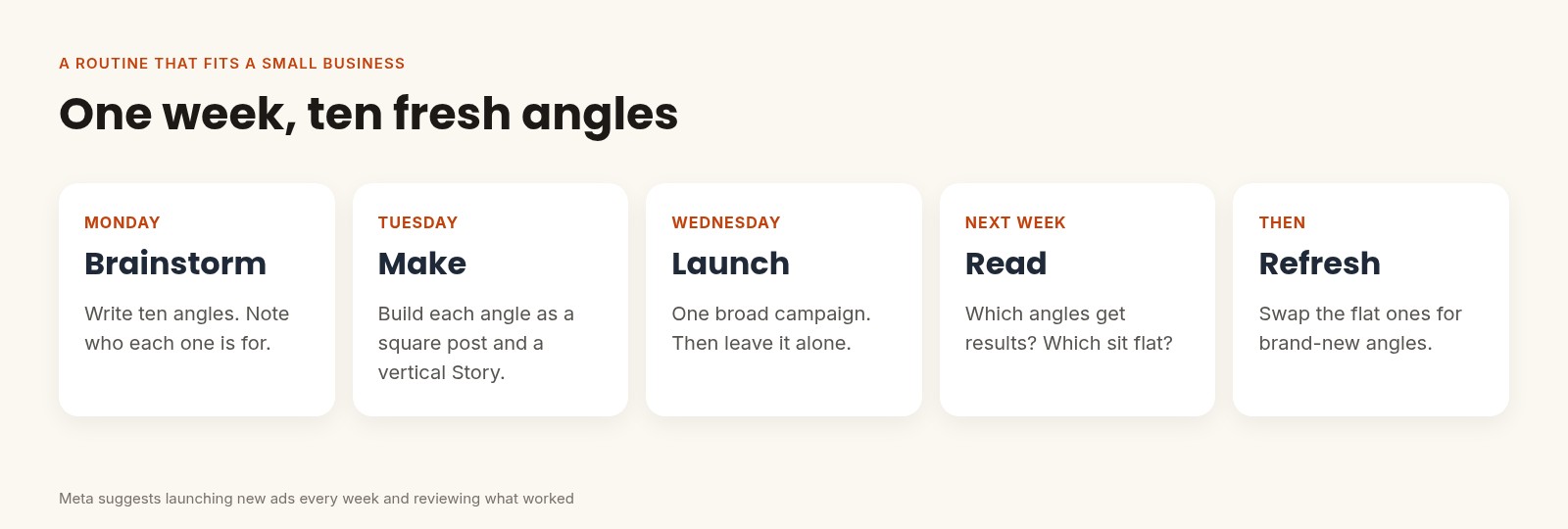
On Monday, write ten angles and next to each one jot down who it's for. On Tuesday, turn each angle into a square post and a vertical Story. On Wednesday, put them all into one broad campaign and then, honestly, leave it alone for a few days. The following week, look at which angles are pulling their weight and which are sitting flat. Swap the flat ones for brand-new angles, not the same ad in a new colour.
This also takes care of creative fatigue, which Meta describes as people being "overexposed to the same creative." It also separately warns about creative similarity, when ads are "visually too alike, even if technically different assets." A weekly refresh handles both.
The hard part is making the ads
Nobody really argues with any of this. The trouble is time.
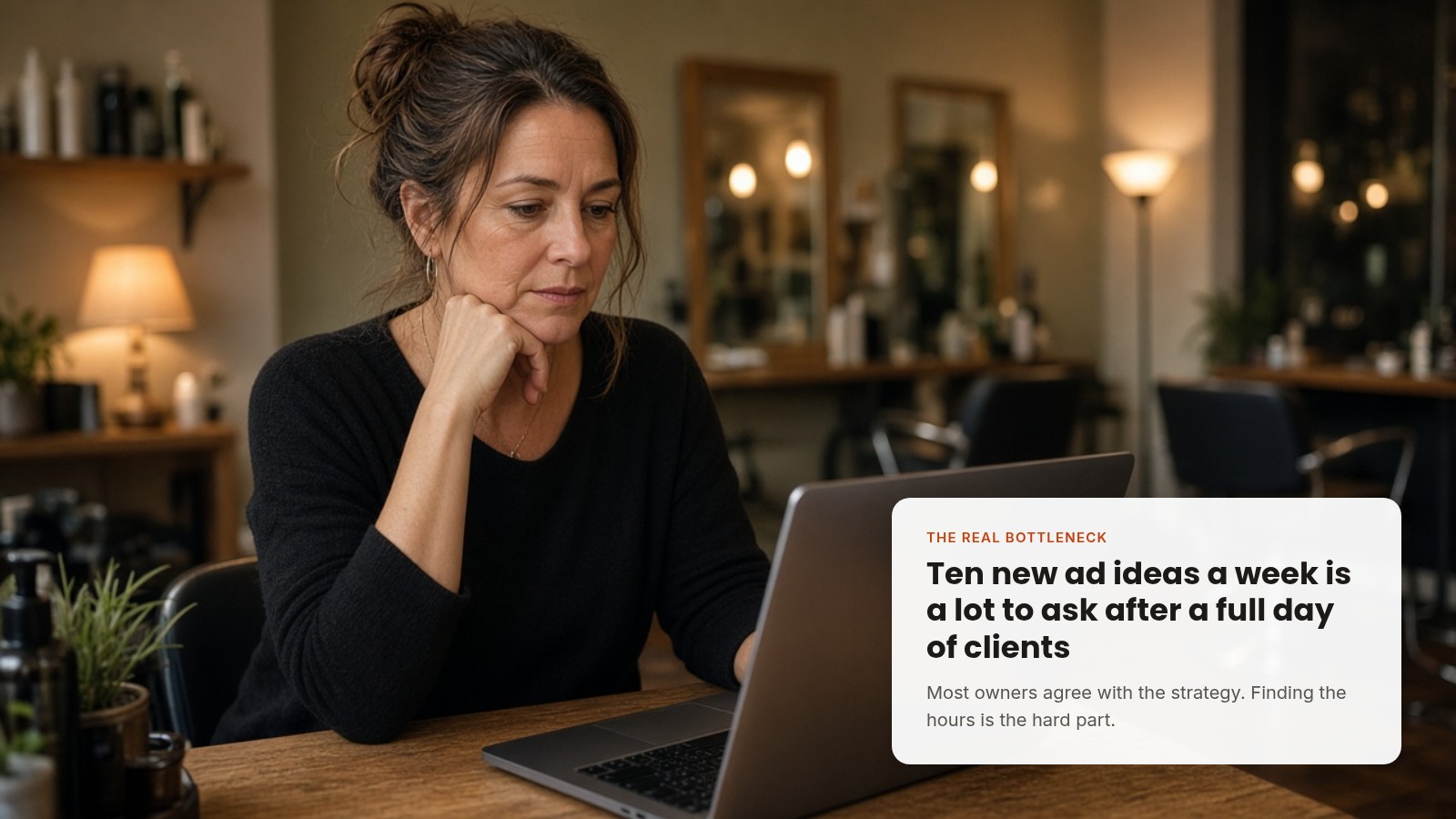
Picture a salon owner on her feet from nine to seven. Ten new angles a week, with pictures, copy and every size, is a part-time job on top of a full-time one.
That's the gap we built AdStorm to fill.
You give it your website or a product page and it pulls out the details and a set of angles to work from. With one click you get dozens of fresh angle ideas, pick the ones you like, and it builds complete ads around them, visuals plus headlines, descriptions and calls to action, in multiple copy and graphic variations rather than a single design. It produces the right sizes for Facebook feed, Story, Reel and carousel ads, plus Google, TikTok, YouTube, Pinterest, LinkedIn and more, so there's no resizing by hand. You can generate as many design and copy variations as you want and shortlist the good ones.
A few features are especially handy for the "make them look different" problem. AdStorm can create AI product mockups and edit your product photos, changing the setting, lighting or composition, so the same sourdough loaf can sit on a breakfast table in one ad and in an office box in another. It can also make AI UGC-style videos and lets you switch between several AI models for a different flavour. And if you spot an ad you like while scrolling, the Clone Ad feature turns it into a 100% original ad for your own business. You can add your logo and graphics, and create ads in whatever language your customers speak.
It costs $6.99 a month or $67 a year, and there's a 30-day refund if it isn't for you.
A few common questions
What is Meta Andromeda, in plain English?
It's the first filter in Meta's ad system. Out of all the ads you're eligible to see, it picks a shortlist, and other models then choose the winner from that shortlist.
Does it really look at a billion ads a second?
Meta says the full pipeline handles over one billion ads per second on a single GPU server while scoring every eligible ad, and the scoring step alone is above 10 billion per second on one chip. Those are Meta's figures.
Should I trust the 2.4% conversion increase?
Treat it as Meta's own unaudited claim. There's no baseline or test method published, so it's a general signal and not a forecast for your account.
Is audience targeting dead?
No. Your targeting still decides who is eligible. Meta just says the bigger lever now is having a range of genuinely different ads.
I'm a one-person business. How many ads is realistic?
Start with about ten different angles in two formats each. That's twenty ads, which matches Meta's suggested minimum, and you can refresh a few each week.
Give Meta more to work with
You don't need a bigger team or a cleverer audience to do well on Meta in 2027. You need more ads that are really different from each other, and a habit of making new ones.
If you'd like help with that part, try AdStorm at getadstorm.xyz. Paste in your website, pick a handful of angles and see what comes out. It's $6.99 a month, and if it doesn't save you time, you get your money back.